
Compare
Where we win, and where we don't.
A comparison is only useful if it tells you when to buy something else. This one does — the table below, the section crediting what instagrid does better, and three markets we tell you outright to buy elsewhere for.
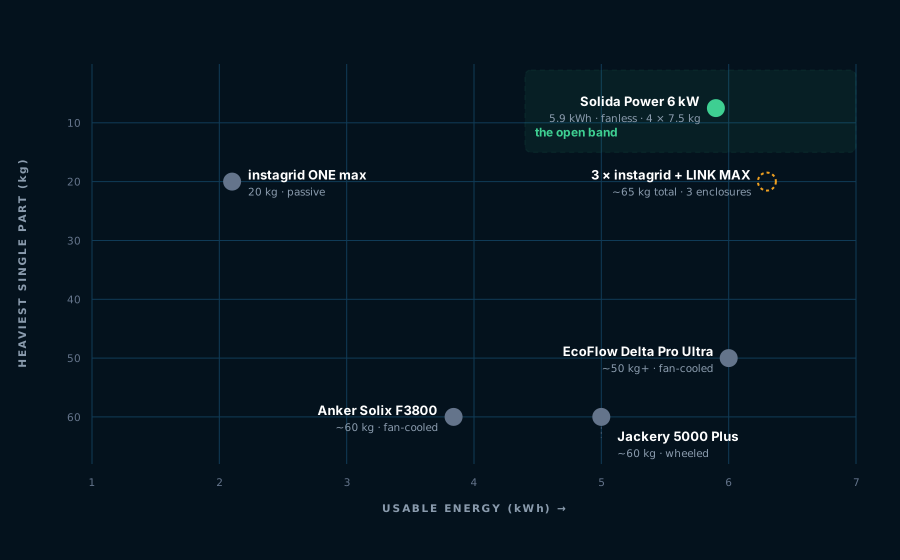
The field
Every unit in this class, side by side.
| Product | Energy | Continuous | Output topology | Mass | Cooling | Enclosures |
|---|---|---|---|---|---|---|
| Solida Power 6 kW | 5.9 kWh | 6 kW | Single-phase | ~30 kg (4 × 7.5 kg) | Fanless, passive | One enclosure |
| 3 × Solida Power 6 kW + connector | ~18 kWh | 6 kW / phase | 3-phase, 3 units | ~90 kg | Fanless, passive | Three units + connector |
| 3 × instagrid ONE max + LINK MAX | 6.3 kWh | ~11 kW | 3-phase 400 V | ~65 kg | Passive | Three units + combiner |
| instagrid ONE max | 2.1 kWh | 3.6 kW (18 kW pk) | Single-phase | 20 kg | Passive | One enclosure |
| EcoFlow Delta Pro Ultra | 6 kWh | 7.2 kW | Split-phase | ~50 kg+ | Fan-cooled | One enclosure |
| Jackery Explorer 5000 Plus | 5 kWh | 7.2 kW | Split-phase | ~60 kg, wheeled | Fan-cooled | One enclosure |
| Anker Solix F3800 | 3.84 kWh | 6 kW | Split-phase | ~60 kg | Fan-cooled | One enclosure |
| Portable Electric Voltstack 8000 | — | replaces 10 kW genset | 3-phase options | Trolley class | Fan-cooled | Trolley |
Against the consumer tier
EcoFlow, Jackery and Anker are not smaller. They are the wrong shape.
On energy alone we are not obviously bigger — the consumer flagships reach 4–6 kWh too, and on peak output some of them beat us. The difference is that all of that energy arrives as one sealed 50–60 kg object with a fan in it.
Sealed, fan-cooled, 50–60 kg
- One sealed object — nothing comes out, so the whole mass moves or nothing does
- Fan-cooled, so audible exactly when the load rises
- A fan intake is also a dust, ash and aerosol intake
- Built to sit in a garage and back up a house, and priced accordingly
- A failed cell block is a service call, not a spare part
Modular, fanless, hot-swap
- Four 7.5 kg modules that come out by hand at the kerb
- No fan and no rotating machinery anywhere in the system
- Nothing drawn through the electronics, so dust and washdown are survivable
- Built for a job site, a set, a shelter and a forward position
- A failed module is a 7.5 kg spare swapped mid-shift
Where they beat us. On cost per kilowatt-hour, and on peak output. If the unit lives in one place, gets moved on tarmac, and nobody minds a fan, a consumer flagship is cheaper and probably the right answer. We would rather you know that now than after you have bought.
Against instagrid
The closest competitor, described accurately.
instagrid is the company whose architecture story is closest to ours, and you should assume they are the competitor in every deal. Their ONE max is 2.1 kWh, 3.6 kW continuous, 20 kg, passively cooled, distributed power electronics. Very close in philosophy.
What they do better
- They have been shipping since roughly 2020, with a service network and a track record we do not have yet
- Their published peak — 18 kW against 3.6 kW continuous per unit, and substantially more across a LINK MAX set — is formidable surge headroom, and surge is what starts motors
- A single 20 kg ONE max is lighter than our whole unit if 2.1 kWh is genuinely all you need
- Their LINK MAX three-unit set is a shipping product with customers using it; ours is a specification
- They are well funded and will contest any claim of architectural novelty, correctly
Where we win
- 5.9 kWh and 6 kW in one enclosure, against 2.1 kWh and 3.6 kW — nearly three times the energy per box
- Our heaviest single part is 7.5 kg against their 20 kg
- Modules are user-swappable in the field, so a flat pack is a two-minute change rather than a return to base
- Fanless at 6 kW, not at 3.6 kW
On three-phase, we are level, and we used to say otherwise. instagrid gangs three ONE max units through a LINK MAX module to reach 400 V three-phase — roughly 65 kg across three enclosures for 6.3 kWh. We do the same thing: three units, each set to a different phase, joined by a combining connector — roughly 90 kg for about 18 kWh. An earlier version of this page claimed we produced three-phase natively from one box. That was wrong, and the claim is withdrawn.
So the sentence is not "world's first distributed inverter," and it is not "three phases from one enclosure" either. It is: 5.9 kWh and six kilowatts, fanless, with no part heavier than 7.5 kg. That is defensible on today's evidence, and it is the claim we intend to keep making.
Not for us
Three markets we are deliberately not chasing.
In each of these our differentiators are wasted and we would be competing on price against better-capitalised incumbents. If this is your use case, buy something else.
Whole-home backup
Powerwall and Delta Pro Ultra own this on cost per kWh. Portability earns nothing in a garage, and the buyer is comparing against installed systems.
Consumer camping and tailgating
Fully commoditised. We would not beat Chinese manufacturing on price, and the buyer cannot perceive the engineering they would be paying for.
Marine and RV
A genuinely good story — carbon monoxide kills on boats too — but the buyer expects consumer pricing. Worth revisiting once industrial volume has brought unit cost down.
Talk to us
Still not sure it fits?
Send us the load list. If a cheaper product does the job we will say so — we would rather lose the sale than be the wrong answer on a job site.